September Newsletter - Place Based Learning, LEGO, and Local History
Stealing, Cardboard, and Other Professional Boundaries
One of my favorite teaching strategies is stealing good ideas from other people.
And I mean this in the most professionally appropriate way possible.
I see something interesting in a museum exhibit, encounter an excellent interpreter or guide at a historic site, or watch a Ken Burns documentary, and I immediately start thinking about how I could adapt whatever professional historians are doing for my students.
This particular project started two years before my students ever actually began researching, when I visited the Martin Luther King, Jr. National Historical Park in Atlanta as part of a National Endowment for the Humanities Institute. (Shoutout to the NEH, whose funding should be substantially increased!)
While I was there, I became really interested in the way the site used historical markers to connect individual buildings to the larger histories of King, the Civil Rights Movement, and the Sweet Auburn neighborhood.
So, naturally, I came home and waited for an opportunity to ask my 7th grade U.S. History students to recreate the idea for our hometown of Richmond, Virginia.
And then I waited some more.
At the time, I was teaching middle school social studies at St. Michael’s Episcopal School in Richmond, and I kept delaying the project because it never felt quite right. Creating the historical markers would require students to spend a lot of time staring at their computers: researching the sites, writing the text, and then designing the markers in Canva’s online design tools. It was connected to the real world, sure, but I wanted students to actually make something. I wanted the project to be tangible and hands-on.
So I saved the idea for a couple of years.
Then, in 2023, my class was in a unit about the 1920s and 1930s, and I saw them struggling with understanding how social, political, and economic changes could impact and be impacted by place. Finally! A way to use the NPS marker! I mentioned the idea to my co-teacher, Reid McBride, and he had the genius idea of having students build the structures to go with their historical markers.
Perfect.
Except there was one problem: I have an absolute hatred of cardboard. And I simply will not allow hot glue into my classroom.
These are boundaries I have established for myself as an educator.
But I did know something else: The Virginia Museum of History & Culture was going to host a LEGO exhibition that fall.
And suddenly I had an idea.
If our students built Richmond's historic structures out of LEGO, then maybe the VMHC would be willing to feature some of their work alongside the exhibition.
Maybe?!
I reached out to my friend Maggie Creech, who was, at the time, the Director of Education at the VMHC and told her our project idea, and she said, “I love it!” Then I asked her if the students’ work could get featured in the exhibit, and she said, “maybe?!”
That was enough for me.
We were going to build Richmond out of LEGO.
Never Build Alone: Creating Community Partnerships through Project-Based Learning
I wanted my students to see that the history we were learning wasn't confined to the people and places in our textbook. Richmond had been shaped by the same forces we were studying, and evidence of that history was still all around us.
In many ways, I wanted them to develop what the National Council for History Education calls one of History’s Habits of Mind: grasping the significance of the past in shaping the present. The Richmond my students knew wasn't inevitable. Its buildings, neighborhoods, monuments, and public spaces were products of decisions made by people before they got there. Learning to see those connections with what people made decades or centuries before meant learning to read their own community historically. They would do that through the research, writing, and creative construction aspects of this project, but I wanted them to see it through the connections we made with our community partners as well.
After reaching out to Maggie at VMHC, she began collecting primary sources from the museum's collection that connected to different landmarks. She also suggested that I reach out to The Valentine, Richmond's history museum, and ask them to do the same.
My friends Marisa Day (former Education Manager) and Laura Earle (E. Claiborne Robins, Jr. Director of Education & Engagement) at The Valentine turned out to be integral contributors to the project as well. They pulled primary sources from their collection about the Richmond sites my students were studying and organized them so students could easily access them as they researched. Laura even drove bags of LEGO to the school in the pouring rain to make sure we had enough for every student to work with as they built their historic structures.
Between the sources, the LEGO, and the people who actually spend their careers preserving and interpreting Richmond's history, our community partners literally made the project possible and made my students so much more motivated to do the more “boring” work of creating historical markers for their sites.
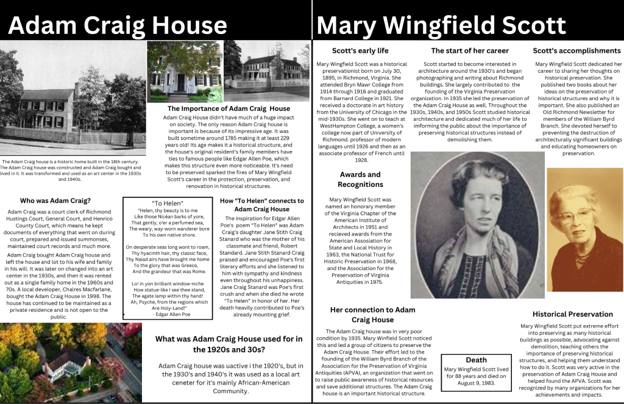
Students chose historic Richmond buildings (based on their own locality and interest) and researched their histories before writing historical markers modeled after the ones I had seen in Atlanta. As they researched, I wanted them to figure out not only what had happened at a particular place, but how that place had been shaped by the city and neighborhood around it and, in turn, how the place had shaped Richmond.
Students had to decide which information mattered, what context an audience would need, and how the history of one building connected to a larger story about the city.
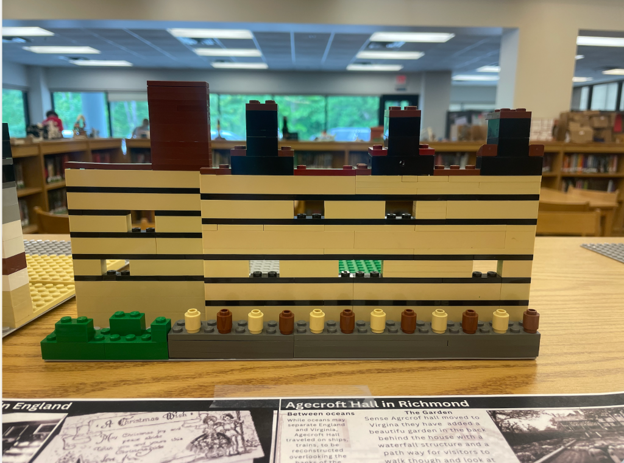
Once students had finished their inquiry-based research and created their historical markers, they sketched their structures using the photographs The Valentine had pulled for them. And once they had a sketch laid out and got it approved, they began to build. Obviously, there were limitations. LEGO can do a lot, but many of the LEGO were donated, and so choice pieces (and colors) were hard to find. But those limitations also forced students to look closely at the photographs and decide which features of their buildings were important enough to preserve and recreate in their models. In that way, even building with LEGO became an exercise in what NCHE calls interrogating sources. Students weren’t simply looking at historical photographs; they were asking questions of them, interpreting the evidence they contained, and then making choices based on that evidence. Their models became, in a small way, arguments about what they believed mattered most in the sources they had examined.
For five days, my classroom was a disaster. Sometimes, late at night, I can still hear the hollow clatter of 17 gallons of LEGO rattling together. But, in the end, the models were very cool. And the stress was worth it.
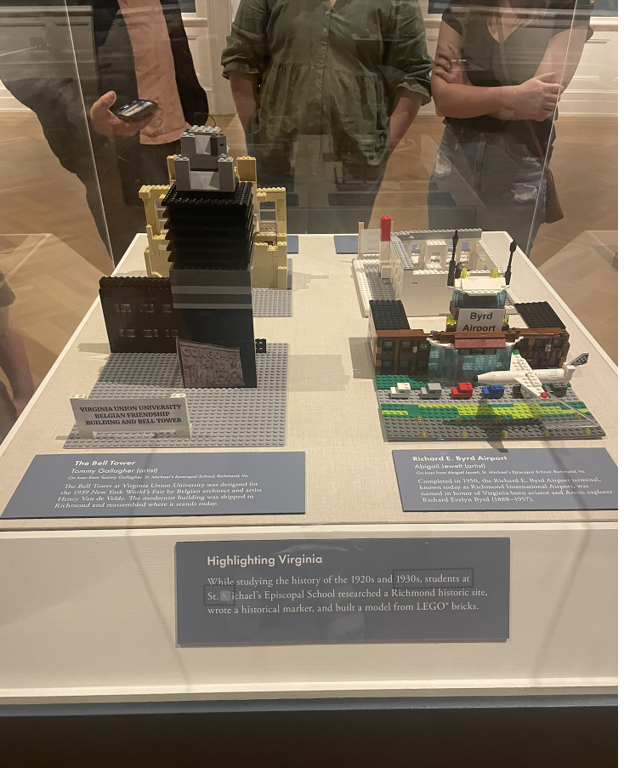
With the help of Maggie and the curators at the VMHC we managed to squeeze four of my students’ projects into the exhibit, Traveling Bricks: An Exhibition Made of LEGO Bricks. As a teacher, I talked about authentic audiences all the time. I wanted students to create things that had some purpose beyond earning points in my gradebook. But there was something different about actually seeing their work in a museum. A project that had started because their teacher went to Atlanta and came back with an idea was now being seen by thousands of people in our community.
The following summer, I worked as a fellow with the Valentine staff, including curator Cristina Vida, Laura Earle, and CeCe D’Arville to help develop supporting materials for Building a City: Richmond’s Landmarks, an exhibition that took some of the ideas we had experimented with in our classroom and expanded them to students across the Richmond metro area.
Ultimately, nearly 500 students and 25 teachers participated in the project. Throughout the school year, students explored Richmond’s built environment using curriculum and research materials provided by The Valentine, selected historically significant Richmond buildings to research, created their own models, and wrote interpretive labels to accompany their work.
I love that this project had a life I never intended for it to have, and that often seems to be the case when it comes to place based learning. When students study their own communities, they begin to recognize that the buildings they drive past, the streets they travel, and the neighborhoods they live in are all products of choices people made before they got there. Some places have been carefully preserved. Others have been changed beyond recognition.
There are a lot of historical questions hiding in those differences.
Why did this building survive?
What used to be here?
Why do we remember this person in this place?
Who decided this was historically significant?
What stories aren't marked at all?
Students ask these questions, and, more importantly, they want to help us answer them. Projects like this give students an opportunity to do the work of professional historians, but teachers don't have to create these opportunities alone. Partners like the Virginia Museum of History & Culture and the Valentine have the collections, expertise, and people who can help our students investigate the places around them and contribute their own thinking to the stories we tell about our communities.
My students' project started because I stole an idea from a historic site in Atlanta. But it became something much bigger because other people were willing to steal it, too.
And I mean that in the most professionally appropriate way possible.
_________________________________________________________________________________
Ready to try Building a City in your own community? Visit lilyPD.wm.edu and create a free account to download the complete collection of Building a City resources and curriculum materials.
And if you’re thinking, “This sounds great, but project-based learning is…a lot,” lilyPD’s Project-Based Learning course launches in October 2026 with practical strategies, videos, and classroom-ready resources from W&M Master Teacher Sam Futrell to help you plan, manage, and actually enjoy project-based learning with your students.
Sam Futrell
Master Teacher at William & Mary