As an organization, the VCHE recognizes that GenAI in teaching and learning is a complex and often contentious issue. The publication of this newsletter does not represent a tacit endorsement of the use of GenAI for history education. We hope that by providing one approach to GenAI we can prompt meaningful deliberation about the future of the technology within the field of history education. We encourage readers to participate in political processes in their schools and communities to support democratic decision making about GenAI.
Who Does the Thinking? Generative AI and the Work of Learning History.
By Amy Allen & David Hicks
VCHE’s commitment to creative approaches to history education invites us to consider how new technologies might support inquiry while preserving the agency of teachers and learners. Students learn history by asking questions, interpreting evidence, examining competing accounts, and making judgments about the past. Generative AI (GenAI) can support all these activities, but it can also do them for students.
Consider an assignment in which students examine primary sources and develop a historical interpretation: GenAI might help them understand an unfamiliar term or ask questions that prompt them to look again at the evidence. But if it analyzes the sources, selects the evidence, and constructs the interpretation before students have made an initial attempt, it has taken over the work the assignment was intended to develop.
This boundary is contextual and open to revision. A student who has already developed a claim might use AI to compare possible ways of organizing the supporting evidence. Another might benefit from questions that draw attention to weaknesses in an argument. In each case, the important question is whether the assistance keeps the learner engaged in interpretation and judgment or brings that work to an early close.
We explored this distinction in an activity we developed for our open-access book, Teaching History with Chatty Geeps. BRINKMANSHIP is a dual-perspective GenAI simulation of the Cuban Missile Crisis designed as an engagement first teaching strategy. We wanted to create conditions for historical decision-making without asking AI to make the decisions itself. See the primary sources used in the BRINKMANSHIP Gen AI simulation below.
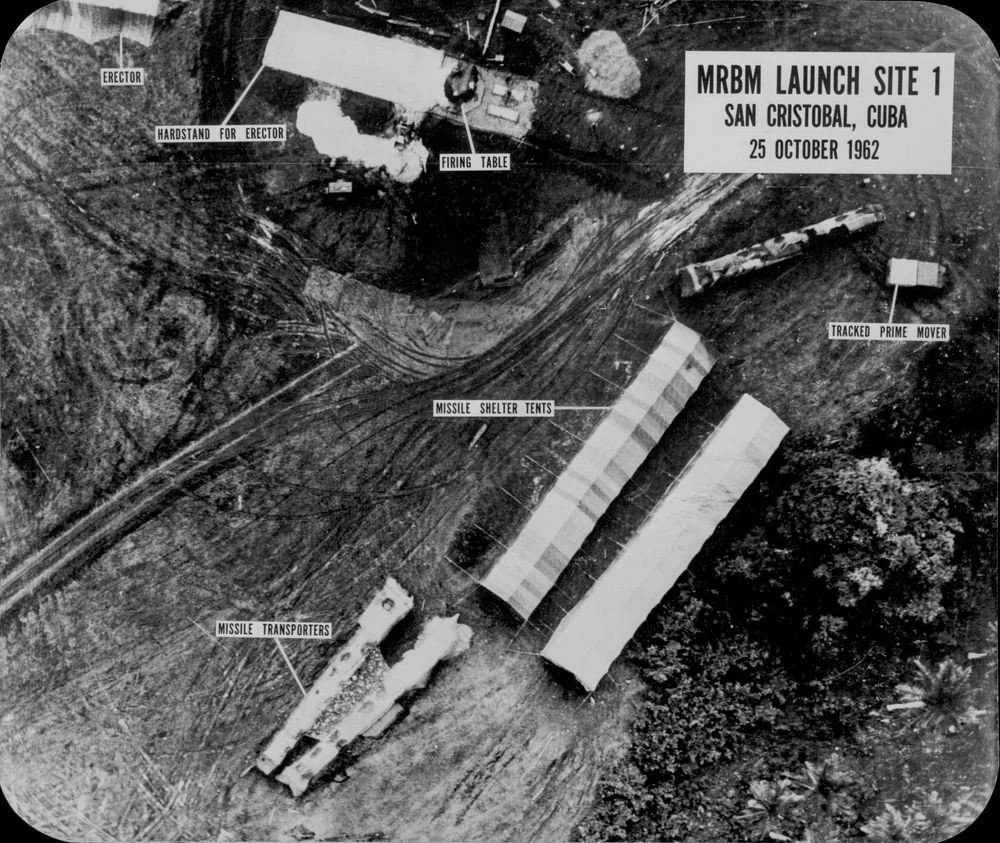
Low altitude reconnaissance photograph of medium-range ballistic missile (MRBM) launch site number 1 in San Cristobal, Cuba showing missile shelter tents, launch pad, transporters, and other equipment. United States. Department of Defense. Department of Defense Cuban Missile Crisis Briefing Materials. (John F. Kennedy Presidential Library and Museum, Boston. Accession Number: PX66-20:16). Retrieved from https://www.history.navy.mil/browse-by-topic/wars-conflicts-and-operations/cuban-missile.html
Students work from either the United States or Soviet perspective and encounter the crisis in stages. At each stage, the AI presents information that decision makers on that side could plausibly have known at the time, along with competing adviser positions, selected evidence, and possible courses of action. It does not reveal what happens next or recommend the “best” decision.
Before advancing, students must choose a course of action and explain their reasoning. What evidence or advice influenced them? What risks concern them? What assumptions are they making about the other side?
The AI does substantial work. It manages the sequence of events, introduces information, and responds to students’ choices. But we designed the activity so that the historical judgment remains with students. They must weigh incomplete information, consider competing pressures, and defend a decision without the benefit of hindsight.
We also had to decide what the AI should not do. In an early version, it generated dialogue that historical advisers might have spoken, an action we are strongly opposed to. We revised the instructions so that the platform would summarize documented positions or present historical evidence instead of inventing quotations and attributing them to real people because the simulation was not meant to be an invitation to have a fictional conversation with Kennedy or Khrushchev. It is an opportunity to investigate how historical decisions emerge through incomplete information, disagreement, and fear of what might happen next.
What happened when a student tried it?
As part of our design testing, we asked an eighth-grade student to work through the simulation. This was a test with one student, not a classroom study. The interaction helped us see what our instructions did and did not accomplish.
Early in the crisis, the student chose a naval quarantine of Cuba. Asked to justify the decision, he initially explained that the Soviets “are not cool.”
The AI did not advance to the next stage or provide a polished rationale on his behalf. Instead, it asked him to connect his decision to the evidence and risks available at that moment. Why might a quarantine be preferable to an immediate attack? What dangers did he see? He subsequently identified avoiding “mutually assured destruction” as a central concern.
This was the kind of exchange we had hoped to create. The AI returned the work of justification to the student while offering questions that helped him attempt it.
Other exchanges were less straightforward. At one point, the student proposed assassinating Khrushchev. The AI continued to present the historical situation, alternatives, risks, and questions rather than simply replacing his response with a more plausible decision.
The full classroom version also includes stopping places and prompts to guide classroom discussion as well as a substantial historical debrief. Students compare their decisions with what happened, examine historical documents, and investigate claims made during the simulation:— because we recognize that even engaged immersion does not, on its own, ensure that students have developed historical understanding.
More thinking or merely more text?
The Cuban Missile Crisis activity demonstrates how the distinction between productive struggle and obstructive friction applies beyond writing. Managing an unfolding sequence of briefings may be work we can ask AI to do so that students can concentrate on interpreting evidence and making decisions.
That does not mean every teacher should use BRINKMANSHIP, or that every history lesson needs GenAI. A teacher can still conduct a decision inquiry with a packet of documents and small-group discussion while another might use GenAI only while planning the lesson.
We want teachers and students to be able to make and defend principled decisions about AI use and non-use. Telling students to use AI “responsibly” leaves the difficult questions unanswered. Responsible for what? Which part of the task? At what point in the process? With what effect on their understanding?
Students need help making these judgments. Before using GenAI, they might identify the problem they want help with and decide which parts of the task they need to attempt themselves. During the interaction, they can examine what GenAI has added, omitted, assumed, or misunderstood. Afterwards, they can consider what they accepted, changed, or rejected and whether they can explain the resulting work without the tool.
We see ourselves as early mapmakers in a live and unstable problem space. Our first maps will contain errors. That uncertainty gives us a reason to look closely at what happens in classrooms, listen to students, and revise our practices as the terrain changes.
Our framework of technocuriosity gives us a way to remain inside these questions. It encourages us to play with these systems and see what they make possible, while also noticing what they take over and how our own thinking changes as we use them. It provides a way to work within the tensions between assistance and substitution, access and dependence, or productive struggle and obstructive friction.
Writing with AI can hollow out authorship and obscure responsibility, but it can also help a person hold, clarify, question, and develop an idea that might otherwise remain unwritten. Our task as educators is to help students recognize the difference, notice when that difference has become difficult to see, and make choices they can explain and defend.
After using AI, does the learner possess more of the thinking, or merely more text?
We invite you to explore these questions with us in Teaching History with Chatty Geeps. The book is free to read and download, and Appendix B includes the full BRINKMANSHIP prompts for both U.S. and Soviet perspectives.